

Dealing with tax debt tied to a spouse’s return is stressful. Innocent Spouse Relief protects people who shouldn’t be held responsible for a partner’s tax errors. Below we explain who qualifies, how to file Form 8857, what understated liability is, and how our tax resolution team can help.
What are the eligibility criteria for IRS Innocent Spouse Relief?
To qualify for IRS Innocent Spouse Relief, joint filers must meet tests showing they didn’t know — and had no reason to know — about an understatement or error. The IRS applies equitable judgment and may relieve liability when it would be unfair to hold one spouse responsible.
IRS Innocent Spouse Relief: legal basis and equitable remedy
Innocent-spouse relief is an equitable remedy under Internal Revenue Code section 6015(f). After reviewing the facts and circumstances, the Secretary of the Treasury may “relieve [an] individual of . . . liability” if it would be inequitable to hold that person responsible for unpaid tax or a deficiency. In short, a joint filer who is normally jointly and severally liable may be relieved when fairness requires it.
Innocent-Spouse Relief and Other Tax Remedies in Bankruptcy, 2024
Who typically qualifies under IRS rules?
Those who usually qualify lacked knowledge and had no reason to suspect underreported income or false deductions. Examples include spouses who trusted a partner to handle finances and had little access to records. Showing you didn’t benefit from the error also helps. A professional review can clarify the facts and improve your claim.
The IRS evaluates several equitable-relief factors, so documenting your role and access to finances is important.
Equitable relief factors the IRS considers
Research shows decision-makers evaluate factors such as whether the spouse knew about the understatement, their role in financial decisions, and whether collection would be unfair. These considerations help the IRS decide which claims merit relief and also highlight related ethical and gender issues.
Professionals’ tax liability assessments and ethical evaluations in an equitable relief innocent spouse case, G Fleischman, 2003
How joint and several liability affects your case
Filing jointly creates joint and several liability, so each spouse can be held for the full tax. You can still seek innocent spouse relief if you were unaware of the underreporting and did not benefit. Understanding shared liability helps you present a clearer, more persuasive claim.
Joint & several liability for married tax filers
Couples who file jointly often lower their combined tax bill, but each filer accepts joint and several liability for the tax. That obligation can survive a divorce, which makes innocent-spouse rules an important protection when one partner’s actions create unexpected tax debt.
How innocent is innocent enough? The relief provisions of Section 6013(e), 1992
How to file Form 8857 to request Innocent Spouse Relief
Submitting Form 8857 begins the IRS review. Provide a concise explanation and attach documents that support why you should not be held responsible for the joint tax.
Step-by-step: completing Form 8857
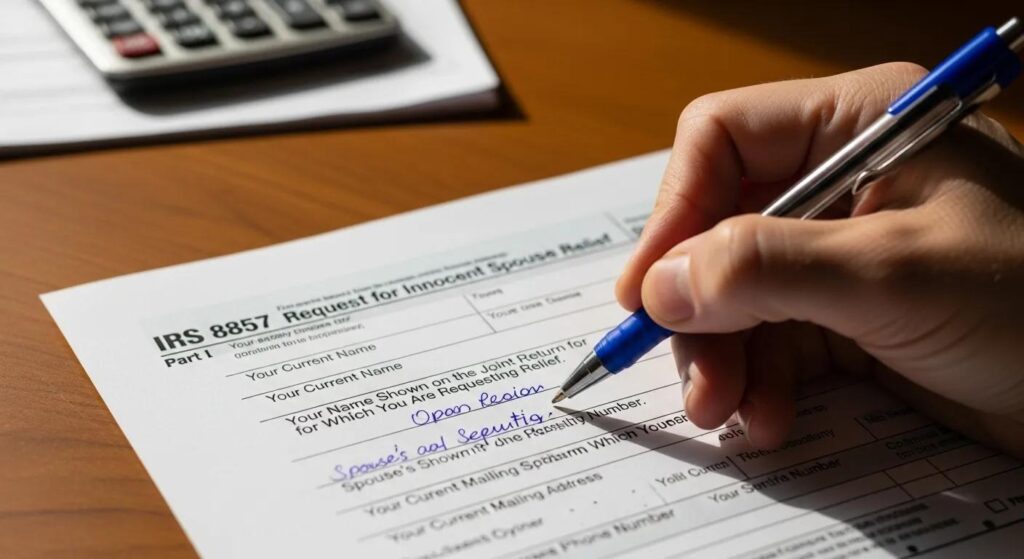
- Obtain Form 8857: Download it from the IRS website or request a paper copy.
- Complete the form: Provide your details, explain why you seek relief, and answer each question clearly.
- Provide supporting documentation: Attach bank statements, W-2s, 1099s, correspondence, and other records that back your account.
- Submit the form: Mail the form and attachments to the address in the instructions and meet any deadlines.
Common mistakes to avoid when filing
Small errors can delay or derail a claim. Aim for a complete, well-documented submission and avoid these issues:
- Incomplete information: Answer all relevant questions fully.
- Missing documentation: Include verifiable proof for statements.
- Late submission: Observe deadlines and the two-year window that applies to some claims.
What is understated tax liability and why it matters
Understated liability occurs when reported income doesn’t match third‑party records (W-2s, 1099s). Notices such as CP2000 propose additional tax; responding promptly with documentation or professional help can reduce penalties and limit collection actions.
How understated liability affects Innocent Spouse claims
If the IRS believes you knew about the underreporting, relief is harder to obtain. Clear, dated evidence showing lack of knowledge and no benefit strengthens your position.
IRS relief options for understated liability
The IRS offers several paths depending on circumstances:
- Innocent Spouse Relief: Relief when you can show you did not know about a spouse’s understatement.
- IRS Installment Agreements: Pay taxes over time when you can’t pay in full.
- Offer in Compromise: Settle for less than the full balance if you meet financial criteria.
- Addressing levies and liens: Professional help can limit or resolve collection steps.
- Wage garnishment solutions: Negotiate relief if garnishments cause undue hardship.
For tailored advice, consult a tax professional.
How expert tax resolution services help with Innocent Spouse cases

We organize evidence, prepare Form 8857, and create a clear narrative for the IRS. We draft submissions, assemble records, and manage deadlines and follow-up so the agency receives a complete, credible claim.
What to expect in a Clear Tax Resolution consultation
Consultations focus on gathering records and building a document-backed case:
- Pull all IRS transcripts: Obtain wage & income and account transcripts to see IRS records.
- Compare IRS data to your records: Match W-2s, 1099s, bank statements, and other documents.
- Identify non-income deposits: Separate transfers, loans, or reimbursements from taxable income.
- Prepare corrections or an amended return: File amendments or submit a dispute package where appropriate.
- Craft a complete response to the IRS: Assemble a clear, documented narrative to support relief.
- Prevent escalation into audits or collections: Request holds or take steps to limit collection while the case is evaluated.
How client success stories show real results
Focused documentation and advocacy can produce favorable outcomes, including granted relief or reduced liabilities.
| Relief Option | Description | Eligibility Criteria |
| Innocent Spouse Relief | Protects an individual from tax debt caused by a spouse’s errors | Must show lack of knowledge and meet IRS equitable-relief standards |
| IRS Installment Agreements | Allows taxpayers to pay taxes over time | Must demonstrate inability to pay in full and meet IRS terms |
| Offer in Compromise | Settles tax debt for less than the full balance when approved | Requires meeting strict financial criteria and IRS approval |
Frequently Asked Questions
What documentation do I need to support my Innocent Spouse Relief claim?
Provide documents showing you had no knowledge: bank statements, W-2s, 1099s, correspondence, and records proving you didn’t benefit. Affidavits from third parties can help. The more dated, complete evidence you supply, the stronger your claim.
How long does it take for the IRS to process Form 8857?
Processing varies but typically takes several months. Case complexity and IRS requests for more information affect timing. If you haven’t heard back in about six months, follow up.
Can I appeal if my Innocent Spouse Relief claim is denied?
Yes. The IRS explains denials and you can appeal or request reconsideration. Submitting additional evidence often helps; a tax professional can guide the appeal.
What are the potential consequences of not filing for Innocent Spouse Relief?
If you don’t file, you may remain liable for taxes, penalties, and interest, which can lead to collection actions like garnishments, levies, or liens. Filing preserves your rights and starts the formal review process.
Is there a fee for filing Form 8857?
No. Filing the form with the IRS is free. You may pay for professional help to prepare the claim; those fees are separate.
What if I have joint debts with my spouse besides taxes?
Innocent Spouse Relief applies only to tax liabilities and generally does not affect other joint debts such as credit cards or loans. For non-tax debts, consult a financial advisor or attorney.
What happens if I don’t apply for Innocent Spouse Relief?
Not applying can leave you liable and subject to collection actions. Filing preserves options to contest liability and may slow aggressive collection while your claim is considered.
Can I apply if I’m divorced or separated?
Yes. Divorce or separation does not automatically bar relief; the key question is whether you lacked knowledge when you signed the joint return.
How does the IRS decide if I qualify?
The IRS examines whether you knew about the understatement, your role in financial decisions, whether you benefited, and whether it would be unfair to hold you liable. Decisions depend on the specific facts and supporting documents.
What if my spouse won’t cooperate?
Your spouse’s cooperation is not required. Provide what documentation you have and explain any lack of cooperation; an experienced advocate can help fill gaps.
Are there time limits to apply?
You often must file Form 8857 within two years of the IRS’s first collection attempt. Older returns can involve extra rules, so act promptly.
Could I receive a refund if relief is granted?
Yes. If relief is granted and you overpaid because of the other spouse’s error, you may be eligible for a refund of the portion unfairly assessed to you.
Conclusion
Innocent Spouse Relief can remove unfair tax burdens caused by a partner’s errors. Know the eligibility rules, file Form 8857 carefully, and gather clear documentation. Our team can review your situation, assemble records, and help submit a strong claim to protect your financial future.