
The first sign is almost always the paycheck, not the mail. The deposit is short, payroll says there is an order on file, and nobody at your employer can tell you anything useful because they are only following instructions they received.
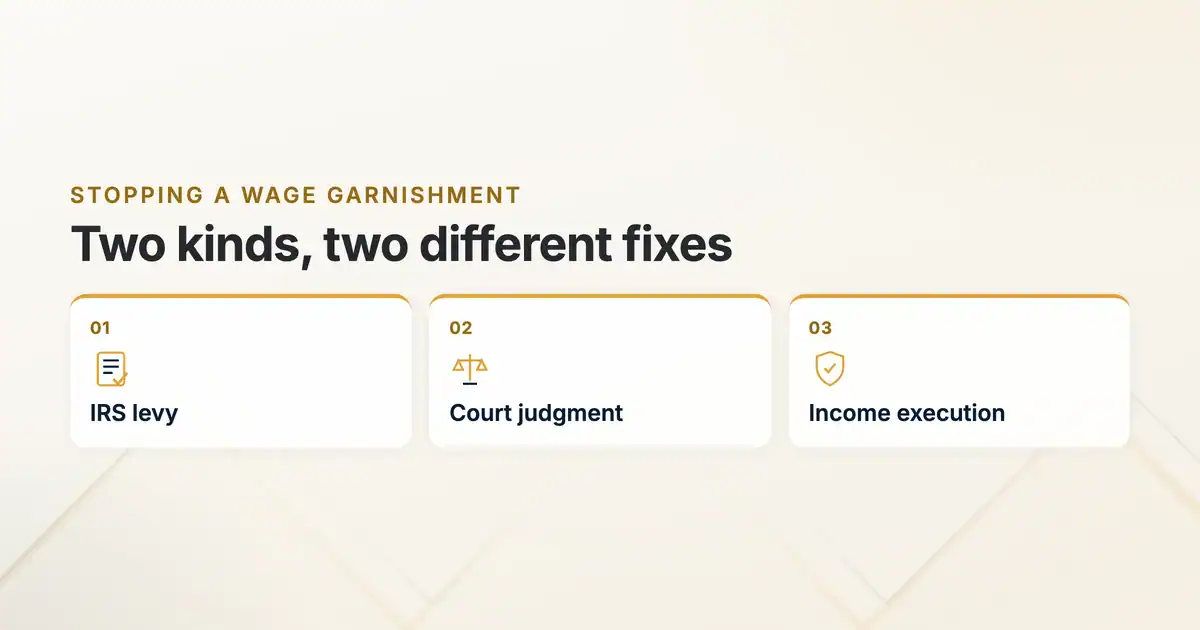
What you do next depends entirely on who is taking the money, and the two most common answers need completely different responses.
How to Stop a Wage Garnishment
Identify who is garnishing first. A creditor with a court judgment is stopped by claiming an exemption, settling, or filing bankruptcy. The IRS is stopped by resolving the account, through an installment agreement, currently not collectible status, an accepted offer, or a timely appeal. New York runs a third process. The wrong remedy does nothing.
First, Which Kind of Garnishment Is This
A court judgment from a creditor
A credit card issuer, a medical provider, a landlord or a debt buyer sued you, won, and got an order directing your employer to withhold. There was a lawsuit, and there was a judgment, even if you never appeared.
How much they can take is capped by federal law. Under the Consumer Credit Protection Act, the maximum subject to garnishment in any workweek is the lesser of 25 percent of disposable earnings, or the amount by which disposable earnings exceed thirty times the federal minimum hourly wage. States may protect more, and New York does.
An IRS wage levy
No lawsuit, no judgment, no court. The IRS does not need one. What it needs is a balance it has assessed, a notice and demand for payment, and a final notice giving you the right to a hearing. After that it can serve your employer directly.
The IRS calls it a levy rather than a garnishment, and it works backwards from a creditor garnishment in a way most people find genuinely surprising. A creditor takes a percentage. The IRS leaves you an exempt amount and takes everything above it.
A New York income execution
New York State collects its own tax debts through an income execution, which is neither of the above. The state asks you to pay voluntarily first, and only routes to your employer if you do not. The mechanics and the numbers are different enough that it needs its own treatment, and this month’s New York post covers it.
If you are not sure which you are facing, the paperwork tells you. A creditor garnishment cites a court and an index number. An IRS levy arrives on Form 668-W. A New York income execution names the Commissioner of Taxation and Finance. If a bank account was frozen rather than a paycheck reduced, that is a different instrument again, and our guide to bank levy versus wage garnishment walks through telling them apart.
How Fast This Actually Moves
Slowly for a long time, and then very fast, and almost everybody misjudges which part they are in.
The IRS side
A federal wage levy is the end of a notice sequence, not the start of one. A balance is assessed and a first notice goes out. Reminders follow, escalating in tone. Then comes a notice of intent to levy, and finally the notice that carries your hearing rights, an LT11 or Letter 1058.
That last one is the one with the clock. You have 30 days from receipt to request a Collection Due Process hearing on Form 12153. Once those 30 days pass without a request and without a resolution in place, the IRS can serve your employer, and from there it is a matter of the next payroll run.
So the sequence can take the better part of a year, and the last stage takes about two weeks. People who have been receiving notices for months read the final one as another reminder, which is exactly what it is designed not to be.
The creditor side
A creditor has to sue you and win first, which takes months. But a default judgment, entered because nobody responded to the lawsuit, arrives on the same schedule as a contested one and is far more common. After judgment, obtaining the wage order is administrative.
What that means for you
If you have a notice in front of you, the question is not how bad the balance is. It is which notice it is and what date is on it. Everything available to you is decided by that.
Stopping an IRS Wage Levy
A wage levy is continuous. The IRS states that once it levies your wages, part of every paycheck goes to the IRS until you make other arrangements, the balance is paid, or the levy is released. It does not expire on its own and it does not stop when the amount taken reaches some threshold. Something has to change.
Filing the missing returns first, and why nothing moves until you do
This is the step people skip and it blocks everything behind it. The IRS will not agree to an installment agreement, will not grant currently not collectible status, and will not consider an offer while required returns are unfiled. You can be sitting on a perfectly reasonable proposal and get nowhere because a return from three years ago was never filed.
If that is your situation, the returns are the job, and they come before everything else.
Getting into an installment agreement
An accepted installment agreement generally stops the levy. You request one by submitting Form 9465 or through the IRS Online Payment Agreement, and for individual balances the streamlined route runs in two tiers, assessed liability under $25,000 and assessed liability from $25,001 to $50,000. Our page on IRS installment plans sets out how the tiers and terms differ, and August’s guide to who is eligible and how to apply goes through the application itself.
Interest continues to accrue on the unpaid balance for the whole term. An agreement makes the balance manageable and stops the enforcement. It does not freeze the number.
Requesting currently not collectible status
If paying anything would leave you unable to meet basic living expenses, then you cannot pay at all right now, and saying so plainly is the correct move. Currently not collectible status suspends active collection while that remains true. It is not forgiveness, the balance stays and interest accrues, but the levy stops. It requires a full financial disclosure and it is reviewed periodically.
The appeal route and its deadline
If the final notice is recent, you have appeal rights with a hard date on them. The IRS gives you 30 days from receipt of an LT11 or Letter 1058 to request a Collection Due Process hearing, which you do by filing Form 12153. That hearing is where collection alternatives get discussed with the Independent Office of Appeals, and a timely request generally suspends levy action while it is pending.
Thirty days is short and it runs from receipt. This is the single most commonly missed deadline in the whole collection sequence.
Economic hardship release
The IRS must release a levy that is creating an economic hardship, meaning it leaves you unable to meet necessary living expenses. This is a specific statutory ground, not a plea, and it is made with documented figures.
Stopping a Creditor Garnishment
Claiming an exemption
Most states, New York included, let you file a claim of exemption asserting that some or all of the withheld wages are protected. Court self-help systems publish the forms and the deadlines, and the deadlines are typically measured in days from when you were served, not from when you noticed.
What the court process looks like
You file with the court that issued the order, the creditor can respond, and a judge decides. It is a real proceeding with a real timetable, and it is where a creditor garnishment gets stopped or reduced.
Settling or resolving the judgment
A creditor that would rather have money than paperwork will sometimes accept a lump sum or a payment agreement to release the garnishment. Get any such agreement in writing before you pay anything.
We do not handle consumer judgment matters. If that is what this is, a consumer attorney or your local legal aid organization is the right call, and saying so is more useful to you than taking the meeting.
How Much They Can Take While You Sort It Out
For a creditor, the CCPA cap above. For the IRS, the calculation runs the other way and depends on your filing status, pay period and dependents, and there is a three-day form that decides it. Get that number before you negotiate anything, and this month’s post on the exempt-amount tables works through it.
For Social Security specifically, the rules are different again, and we cover those in can the IRS really garnish Social Security benefits.
How Long It Lasts If You Do Nothing
A creditor garnishment runs until the judgment is satisfied, which on a growing balance with post-judgment interest can be years. An IRS wage levy runs until the account is resolved or the collection statute expires. Neither is a waiting game you win.
What Does Not Work
Asking your employer to stop. They cannot. An employer served with a levy or a court order that fails to comply becomes liable for the amount they should have withheld, so the person you are talking to has no discretion at all.
Changing jobs. It buys weeks, and the IRS locates new employers through wage reporting.
Ignoring the notices and hoping the account is written off. The collection statute is long and the balance grows the entire time.
Filing something incomplete to buy time. A rejected installment agreement request or a financial statement missing schedules puts you back where you started with weeks gone.
Where We Come In on This One
We are CPAs in Uniondale, and IRS and New York State collection is the work we do. We know how it feels to be reading this. Dealing with tax debt triggers fear, embarrassment and anger, sometimes all three in the same afternoon, and we totally understand.
What we would do first is get the notices in front of us and read the dates, because the dates decide what is still available. Then we pull the account transcripts to see what the IRS actually has, which is regularly not what the taxpayer believes. Then we pick the remedy that fits the numbers, not the one that sounds best.
You can read about our wage garnishment work, which is where most of these cases start.
Guy’s background and credentials are on his bio page if you want to know who you would be working with.
Or just tell us what landed in your mailbox and we will tell you which clock you are on.
FAQ
Is there a way to get around wage garnishment?
Not by avoiding it, but there are several ways to end it. For an IRS levy, resolving the account through an installment agreement, currently not collectible status or an accepted offer will do it, and a timely Collection Due Process request suspends levy action while the appeal is pending. For a creditor garnishment, a claim of exemption, a settlement, or bankruptcy are the routes. What does not work is asking your employer to ignore it, because they become liable for what they fail to withhold.
What is the most they can garnish from your paycheck?
For a creditor with a court judgment, federal law caps it at the lesser of 25 percent of disposable earnings or the amount above thirty times the federal minimum hourly wage per week, and states can protect more. For the IRS the cap works in reverse. It leaves you an exempt amount set by Publication 1494 based on your filing status, pay period and dependents, and takes the rest. That means an IRS levy can take a much larger share than a creditor ever could.
Can I stop a garnishment from happening?
Yes, and it is far easier before it starts than after. With the IRS, every notice in the sequence before the final notice is an opportunity, and the final notice itself carries 30 days to request a hearing. Acting at CP504 rather than at LT11 leaves you with more options and more time. With a creditor, responding to the lawsuit before a default judgment is entered is the equivalent moment.
How long does wage garnishment typically last?
Until the underlying debt is resolved. A creditor garnishment continues until the judgment plus post-judgment interest is satisfied. An IRS wage levy is continuous and runs until you make other arrangements, the balance is paid, or the levy is released. There is no fixed term on either, which is why both are ended by dealing with the debt rather than by waiting.