
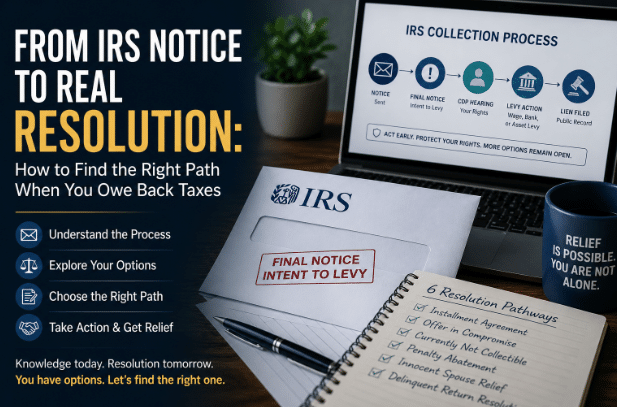
When you owe the IRS, the problem doesn’t stay contained to one corner of your life. It bleeds into everything. According to the IRS Data Book, the agency pursues millions of collection actions each year. Liens, levies, and garnishments that escalate automatically through a defined sequence. Understanding where you are in that sequence determines which resolution options are still available to you.
Key Takeaways
- The IRS collection process follows a fixed escalation sequence. Every stage you miss closes off procedural protections that can’t be recovered.
- Under IRS guidelines, failure-to-pay penalties accrue at 0.5% per month on unpaid balances. A compounding cost that makes delay genuinely expensive, not just stressful.
- Six primary resolution pathways exist: installment agreements, Offer in Compromise, Currently Not Collectible status, penalty abatement, innocent spouse relief, and delinquent return resolution.
- Which option you qualify for depends on income, assets, filing history, and how far collections have progressed. Not just the dollar amount you owe.
- A free consultation with a qualified CPA costs nothing and gives you a factual picture of your options before you commit to any path.
What’s Actually Happening When the IRS Begins Collecting?
The IRS collection process isn’t random or personal. It runs on a documented sequence that moves from notice to enforcement with mechanical consistency. It starts with a balance-due letter. If that goes unanswered, the IRS issues a CP504 Notice, a precursor to levy action, followed by a Final Notice of Intent to Levy, which triggers your right to request a Collection Due Process (CDP) hearing. That hearing window is 30 days. Miss it, and you’ve forfeited one of the strongest procedural protections the tax code provides.
After that window closes, the IRS can move to wage garnishment, bank levies, and tax lien filings without additional warning.
The IRS Restructuring and Reform Act of 1998 formalized many of the taxpayer rights built into this process. But those rights only matter if you know they exist and act on them in time.
The real problem isn’t the debt itself. It’s the enforcement machinery running in the background while you’re still deciding what to do.
Why Do People Stay Stuck Even When They Know They Need to Act?
The most common reason isn’t indifference. It’s a specific feedback loop: the worse the situation feels, the harder it becomes to look at it directly. So IRS notices stack up on a counter, the balance climbs, and the mental cost of engaging keeps rising. Which makes it easier to postpone again.
The second reason is a justified distrust of the tax relief industry. Many people who call a resolution firm for the first time have already been burned. Charged large upfront fees by a national debt-relief company that provided little follow-through. That experience makes it harder to accept legitimate help when it’s actually available.
Both obstacles have the same resolution: a factual, no-commitment assessment of where you actually stand. Not a sales pitch. A real read on your options from someone whose job is to advocate for you, not process your account.
What Are the Six Resolution Pathways, and How Do You Know Which One Fits?
Tax relief isn’t a single product. It’s a category of distinct legal and procedural options, each with its own eligibility requirements. Here’s how to think through them.
Installment Agreement. If you can pay the full balance over time but need structured monthly payments, an installment agreement is the most straightforward path. The IRS offers both streamlined and non-streamlined IRS installment plans depending on what you owe and how quickly you can pay. Penalties and interest continue to accrue during repayment, which is why negotiating the right structure matters.
Offer in Compromise (OIC). This is the IRS program that allows certain taxpayers to settle for less than the full amount owed. The IRS uses a formula called Reasonable Collection Potential. Which accounts for your monthly disposable income multiplied by a set number of months, plus the net equity in your assets, to determine whether a reduced settlement is appropriate. Consider a typical case: a self-employed contractor with $55,000 in tax debt, minimal asset equity, and variable income might qualify for a settlement significantly below that figure. Only if the OIC is prepared correctly with complete financial documentation. An improperly filed offer gets rejected and restarts the clock. You can review how this program works through IRS Offer in Compromise guidance before your consultation.
Currently Not Collectible (CNC) Status. When your income genuinely doesn’t cover basic living expenses after IRS National and Local Standards are applied, the IRS can place your account in a temporary hold. Enforcement stops. The underlying balance doesn’t disappear, but no active collection action can proceed. This gives you time to stabilize without the pressure of garnishment or levy.
Penalty Abatement. IRS failure-to-pay and failure-to-file penalties can compound to 25% or more of the underlying balance, according to IRS guidance on penalty structures. First-time penalty abatement, a formal IRS program for taxpayers with a clean prior compliance history. Is one of the most consistently underused options available. The debt doesn’t go away, but a substantial portion of what you owe can be removed if you qualify.
Delinquent Return Resolution. Nothing else moves until your unfiled returns are filed. If you don’t file, the IRS will prepare a Substitute for Return on your behalf. It won’t include any deductions or credits you’re entitled to, filing your own returns almost always produces a lower balance. This is the required first step before any other resolution pathway can proceed.
Innocent Spouse Relief. If the debt originates from a joint return where your spouse understated income or claimed improper deductions without your knowledge, you may qualify for separation of liability. This is a narrower program with specific eligibility requirements, but it’s an important option when the circumstances fit.
How Long Does Resolution Actually Take?
This is the right question to ask before you commit to anything.
Timelines vary by pathway. An installment agreement can typically be established within a few weeks. An Offer in Compromise, according to IRS processing data, takes an average of six to twelve months from submission to a final decision. Sometimes longer if additional documentation is requested or the offer is returned for correction. Currently Not Collectible status can often be requested more quickly, but it requires documented financial hardship with supporting records.
What the process looks like with qualified representation: your CPA pulls your IRS transcripts to establish a complete picture of what’s owed and why, analyzes which resolution options you’re eligible for based on your actual financial numbers, prepares and submits the appropriate forms, and handles all IRS correspondence directly. You’re not on the phone with a collections representative. You’re not navigating the paperwork alone.
The IRS representative managing your account has one function: to collect. That’s not a criticism. It’s an accurate description of their role. A CPA or enrolled agent representing you has a different job entirely: to find the best legally available outcome for your specific situation, using every option the tax code permits.
Acting Now vs. Waiting: What the Comparison Actually Shows
| Factor | Working with Fine & Clear Tax Solutions | Waiting, Going It Alone, or Using Unqualified Help |
| Penalties and interest | Addressed through resolution strategy | Continue compounding at 0.5% per month (IRS failure-to-pay rate) |
| Enforcement (garnishment, levies) | Halted through active representation | Continues or escalates through automatic IRS sequence |
| Resolution options available | Full range assessed against current eligibility | Narrows as time passes and financial picture shifts |
| IRS communication | Handled by your representative | Handled by you, without procedural knowledge or leverage |
| Filing errors and missed deductions | Corrected through proper return preparation | Locked in, often permanently |
| OIC eligibility | Analyzed and optimized with complete documentation | May lapse if financial circumstances change or offer is filed incorrectly |
| Cost | Professional fee weighed against resolution outcome | Compounding balance, narrowing options, and enforcement consequences |
The most expensive decision in a tax debt situation is usually the one that feels like not making a decision at all.
Who Should Know This Isn’t a Guaranteed Fix
Honest outcomes matter more than comfortable ones.
Tax relief doesn’t automatically reduce what you owe. Every IRS program has specific eligibility standards, and not everyone qualifies for every option. An Offer in Compromise requires documented financial hardship. If you have significant assets or consistent income, the IRS will expect to collect closer to the full balance. CNC status is temporary by design; if your financial situation improves, the IRS can reinstate collection activity.
Resolution also requires sustained compliance on your end. An installment agreement that defaults reverts to active enforcement. An OIC that’s accepted can be voided if you fail to file required returns in the years following settlement.
What qualified representation actually provides is confidence that you’re pursuing the right pathway, prepared correctly, with realistic expectations about the outcome. At Fine & Clear Tax Solutions, no specific dollar reductions are promised. But every resolution strategy is built on your actual numbers, not a general estimate.
7 Questions People Ask Before Getting Help
How do I know if I qualify for an Offer in Compromise?
The IRS uses the Reasonable Collection Potential formula. Your monthly disposable income multiplied by a set factor, plus net asset equity. To evaluate OIC eligibility. If the result is less than your total balance, you may qualify. A CPA can run this analysis before you commit to anything.
What happens if I keep ignoring IRS notices?
The IRS escalates automatically. From balance-due letters to Final Notice of Intent to Levy to active garnishment, bank levies, and lien filings. Ignoring notices doesn’t pause the process. It removes your procedural protections and accelerates enforcement.
Can I negotiate with the IRS on my own?
You can. But the IRS representative you’re speaking with isn’t advising you. They’re processing your account. They won’t volunteer options you didn’t ask about, and most people who attempt self-representation either accept worse terms than they qualify for or make procedural errors that permanently close off better options.
What if I have several years of unfiled returns?
Filing those returns is the first step before any resolution can move forward. The IRS may have already filed Substitute for Returns on your behalf. Which typically overstate your balance by omitting deductions you’re entitled to. Filing correctly almost always reduces the amount you actually owe.
How much does professional tax resolution cost?
Fees vary based on the complexity of your situation. The relevant comparison isn’t the fee against zero. It’s the fee against compounding penalties, narrowing resolution options, and the enforcement consequences of going it alone or working with someone unqualified to handle IRS procedures.
How do I get started with Fine & Clear Tax Solutions?
Call 516-209-2594 or schedule a free consultation directly. The first conversation is a no-commitment assessment of your situation. What you owe, where you are in the IRS collection sequence, and which options are realistically available to you.
You Already Know Something Has to Change
The IRS doesn’t pause because life is complicated. Penalties accrue. Collection windows narrow. The gap between “I’ll handle this soon” and “my wages are being garnished” is shorter than most people expect.
If you’ve read this far, you’re not confused about whether to act. You’re deciding who to trust.
Fine & Clear Tax Solutions has spent 17 years working through exactly these situations – delinquent tax returns, wage garnishments, IRS debt that feels impossible to move. Guy A. Finocchiaro, CPA, leads a team that handles IRS communication directly, builds your resolution strategy on your actual financial numbers, and keeps the process as straightforward as possible on your end.
Call 516-209-2594 or schedule your free consultation today. You’ll leave knowing exactly where you stand. And what a real path forward looks like.
About the Author
Fine & Clear Tax Solutions is a CPA-led tax resolution firm with 17 years of experience helping individuals and business owners resolve IRS tax problems. They specialize in back taxes, wage garnishment, delinquent returns, and Offers in Compromise, providing expert guidance and direct IRS representation to clients nationwide through remote consultation and personalized resolution strategies.