
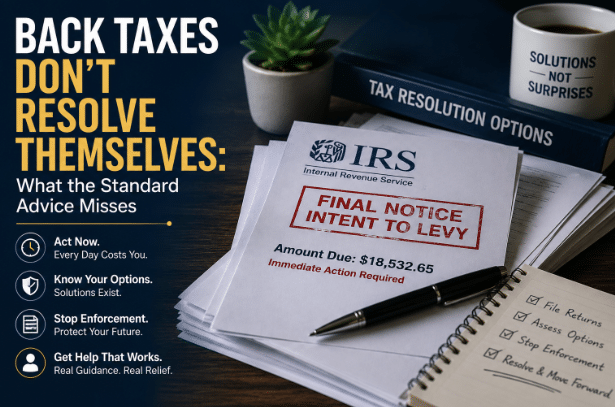
Owing back taxes to the IRS isn’t just a financial problem. It’s an enforcement problem. Every week without a formal resolution, penalties compound, collection actions escalate, and resolution options close off one by one. Understanding which options are still available to you, and acting before more of them disappear, is what separates a manageable outcome from a damaging one.
Key Takeaways
- Filing all delinquent returns is the mandatory first step before any IRS resolution program becomes available. Without it, the IRS won’t negotiate.
- An Offer in Compromise lets eligible taxpayers settle for less than the full amount owed, but eligibility depends on a specific IRS formula most people miscalculate without professional guidance.
- Active enforcement, wage garnishment, bank levies, tax liens, doesn’t pause while you research your options. It continues on the IRS’s schedule.
- The longer enforcement runs without a formal response, the fewer resolution paths remain open.
- Realistic outcomes require an honest review of your financial situation; no qualified professional can promise specific results before seeing your file.
Why Do Back Tax Situations Feel Impossible to Resolve Alone?
The short answer: the IRS isn’t advising you. It’s collecting from you.
When you call the IRS, the representative on the phone is processing your account. They’ll answer the specific question you ask. What they won’t do is tell you that a different question would have gotten you a better outcome, or that your situation might qualify you for a program you haven’t asked about. That gap between what the IRS processes and what you’re actually entitled to is where cases go wrong.
The IRS’s Substitute for Return program makes this concrete. When you don’t file, the IRS files a return on your behalf. And that substitute return never includes your deductions, credits, or legitimate expenses. It calculates the highest possible liability. Taxpayers who’ve had substitute returns filed often owe significantly less once a properly prepared return is submitted. But the IRS won’t volunteer that information. You have to know to ask for it, and you have to know how to document it.
What Makes Back Tax Cases Harder Than the Standard Advice?
Most general guidance follows a clean three-step sequence: file your returns, set up a payment plan, move on. That sequence isn’t wrong. It’s just incomplete in every way that matters.
The first problem is timing. According to IRS guidance, a past-due return that’s accurately completed typically takes several weeks to process. During that processing window, interest and penalties continue to accumulate. And if a Notice of Deficiency (CP3219N) is already in play, the taxpayer has 90 days to file or petition the Tax Court. Miss that window, and the options narrow significantly. The IRS publishes these timelines, they’re not hidden, but navigating them without professional guidance means understanding which notices trigger which deadlines, and what each deadline actually forecloses.
The second problem is eligibility. Resolution programs have conditions that aren’t widely advertised, an IRS Offer in Compromise. The program that lets qualifying taxpayers settle their debt for less than the full amount. Uses the IRS’s Reasonable Collection Potential (RCP) formula to determine eligibility. RCP accounts for your income, allowable living expenses, asset equity, and future earning capacity. Submit incomplete documentation or miscalculate the formula, and the IRS rejects the application automatically.
There’s also a refund window that most taxpayers don’t know about. Under IRS rules, you must file within three years of the original due date to claim a refund from that year. After that, the refund is gone permanently. The IRS doesn’t remind you. It simply keeps the money.
The Real Problem Isn’t the Debt. It’s the Enforcement Running Behind It.
This reframe matters. The dollar amount you owe isn’t the most urgent problem. What the IRS is doing, or preparing to do, about it is.
A tax lien is a public record that attaches to your property and degrades your credit. A bank levy can freeze your account without advance notice on the day it’s executed. Wage garnishment can claim a substantial portion of every paycheck. None of these actions pause while you think through your options. They run on the IRS’s schedule, not yours.
The most expensive decision in a back tax situation isn’t hiring professional help. It’s waiting.
Consider what a typical escalation path looks like. A self-employed contractor receives a CP501 notice, a balance-due reminder, and sets it aside. Life is busy. A CP503 arrives. Then a CP504, which is the IRS’s notice of intent to levy. By the time a Notice of Federal Tax Lien is filed, the taxpayer’s credit is already affected, and the resolution options still available require more documentation, more time, and more formal process than they would have at Stage 1. That progression doesn’t take years. It can happen within months.
Resolution Options vs. Inaction: What’s Actually at Stake
The table below compares the outcome trajectory of acting promptly with qualified representation against waiting, self-managing, or relying on unqualified help. It’s not about comparing price points. It’s about comparing outcomes.
| Factor | Acting with Fine & Clear Tax Solutions | Waiting / Going It Alone |
| Resolution path | Assessed and matched to your actual financial situation | Often the first option found, not necessarily the best one |
| Enforcement during process | Formal requests filed to halt or reduce active garnishments and levies | Continues unchecked while you research |
| Return preparation | Delinquent years prepared to minimize liability, not just filed | Often filed based on available records without maximizing deductions |
| OIC eligibility | RCP formula applied correctly with full documentation | Commonly miscalculated, leading to automatic rejection |
| IRS communication | Handled by authorized representative with procedural knowledge | Handled directly by taxpayer without representation rights |
| Cost of mistakes | Minimized through professional preparation | Penalties, rejected applications, and missed refund windows accumulate |
| Ongoing compliance | Strategy built around preventing recurrence | Resolution focused on current debt only |
The frame that matters: Fine & Clear Tax Solutions fee is protection against a quantifiably larger downside. The wrong resolution path, a rejected OIC application, an unchallenged wage garnishment. Those outcomes cost far more than professional guidance.
How Fine & Clear Tax Solutions Actually Approaches This
The process starts with a free consultation. A real review of where your account stands, not a generic intake call. Guy A. Finocchiaro, CPA, and the team assess what you owe, what enforcement actions are active or pending, and which resolution programs you’re eligible for based on your actual financial picture.
From there, the work is handled on your behalf. You don’t need to call the IRS, interpret notices, or negotiate directly. Authorized representatives have procedural standing that individual taxpayers don’t. They know which forms to file, which programs to request, and how to document eligibility in a way that holds up. That’s what’s behind the firm’s hands-on approach to minimizing client effort. It’s not a marketing concept. It’s how effective IRS representation actually works.
For delinquent tax returns, that means preparing all outstanding years in a sequence designed to minimize total liability and establish the compliance record the IRS requires before any resolution agreement can move forward. For active enforcement, it means filing the appropriate requests to stop garnishments or levy actions while a resolution is being negotiated.
Honest framing on outcomes: not every client qualifies for every program. An installment agreement spreads payments over time. An Offer in Compromise may reduce the total owed. But only for taxpayers whose RCP calculation supports it. Penalty abatement removes certain penalties for taxpayers who meet specific IRS criteria, including first-time penalty abatement and reasonable cause determinations. Any firm that promises specific outcomes before reviewing your financials isn’t being straight with you.
Who This Matters Most For
This matters most when enforcement is already active, when multiple years of returns remain unfiled, or when the total debt is large enough that the wrong resolution path would cost substantially more than qualified professional guidance.
It’s also the right call when you’ve already tried to handle this yourself and hit a wall. A rejected installment agreement, a notice you can’t interpret, or a response from the IRS that made the situation worse instead of better.
The scenario where people sometimes assume they don’t need help: small balances with no active enforcement. Even there, the risk is underestimating how quickly Stage 1 becomes Stage 3. The IRS escalates on its own schedule. The gap between a first notice and an active levy is shorter than most people expect, and by the time enforcement is running, the resolution window has already narrowed.
FAQ
Can I set up a payment plan directly with the IRS without professional help?
You can. The IRS offers an Online Payment Agreement tool for direct applications. But the plan you get on your own may not be the most favorable one available. A tax professional can negotiate terms that reflect your actual financial situation and can identify whether a different program. Penalty abatement, an OIC, or currently-not-collectible status. Would cost you less overall.
What happens if I keep ignoring IRS notices?
The process accelerates. Each unanswered notice moves your account closer to enforced collection: liens, levies, garnishments. The IRS doesn’t need your participation to escalate. It just needs time. Ignoring notices doesn’t buy time. It costs it.
How long does resolving back taxes typically take?
It depends on the resolution path and how quickly filings and documentation are completed. An installment agreement can often be established relatively quickly once returns are filed. An Offer in Compromise involves a more involved financial review and takes considerably longer. Anyone who gives you a specific timeline without reviewing your file is guessing.
Does an Offer in Compromise actually work?
Yes. For taxpayers who qualify and who submit complete, accurate documentation. The IRS applies the Reasonable Collection Potential formula to every application. If your income and asset picture suggests you can pay the full debt over time, the offer will be rejected. Proper preparation is what separates an approved application from an automatic rejection.
Can wage garnishment be stopped after it’s already started?
Yes. An active garnishment can be stopped through a formal resolution agreement, a currently-not-collectible status determination, or a collection appeal. It doesn’t stop on its own, and it doesn’t pause during negotiation. The faster a formal response is filed, the more income is protected.
What if I haven’t filed tax returns in several years?
Filing all outstanding returns is the required first step before any resolution program becomes available. The IRS won’t consider a payment plan or an OIC on unfiled years. Filing late is always better than not filing. And in many cases, a properly prepared return will show a lower liability than the IRS’s substitute return calculated.
Is it too late to act if a bank levy has already been executed?
Not necessarily. A levy release can be requested through formal channels, and in certain cases where the levy was procedurally improper, funds can be returned. But this requires immediate action and authorized representation. The window is short and it closes quickly.
Don’t Let the Gap Between Notices and Enforcement Close Without a Plan
If you’re sitting with IRS notices, an active garnishment, or years of unfiled returns, you already know this isn’t a problem that resolves on its own. The IRS doesn’t get frustrated and give up. It escalates.
Fine & Clear Tax Solutions offers a free consultation. A real review of your situation and your options, with no obligation. Call 516-209-2594 or schedule your free consultation directly to find out which resolution paths are still available to you and what it would take to close this out. The conversation costs nothing. Every week without one costs more.
About Fine & Clear Tax Solutions
Fine & Clear Tax Solutions is a CPA-led tax resolution firm helping individuals and business owners resolve IRS tax problems. Led by Guy A. Finocchiaro, CPA, the firm specializes in back taxes, delinquent returns, wage garnishments, offers in compromise, and IRS collections defense. Clients are served nationwide through remote representation, and free consultations are available to anyone facing IRS enforcement or tax debt.
Sources
IRS. Filing Past-Due Tax Returns. https://www.irs.gov/businesses/small-businesses-self-employed/filing-past-due-tax-returns
IRS. Offer in Compromise. https://www.irs.gov/payments/offer-in-compromise
IRS. Understanding Your CP3219N Notice. https://www.irs.gov/individuals/understanding-your-cp3219n-notice