
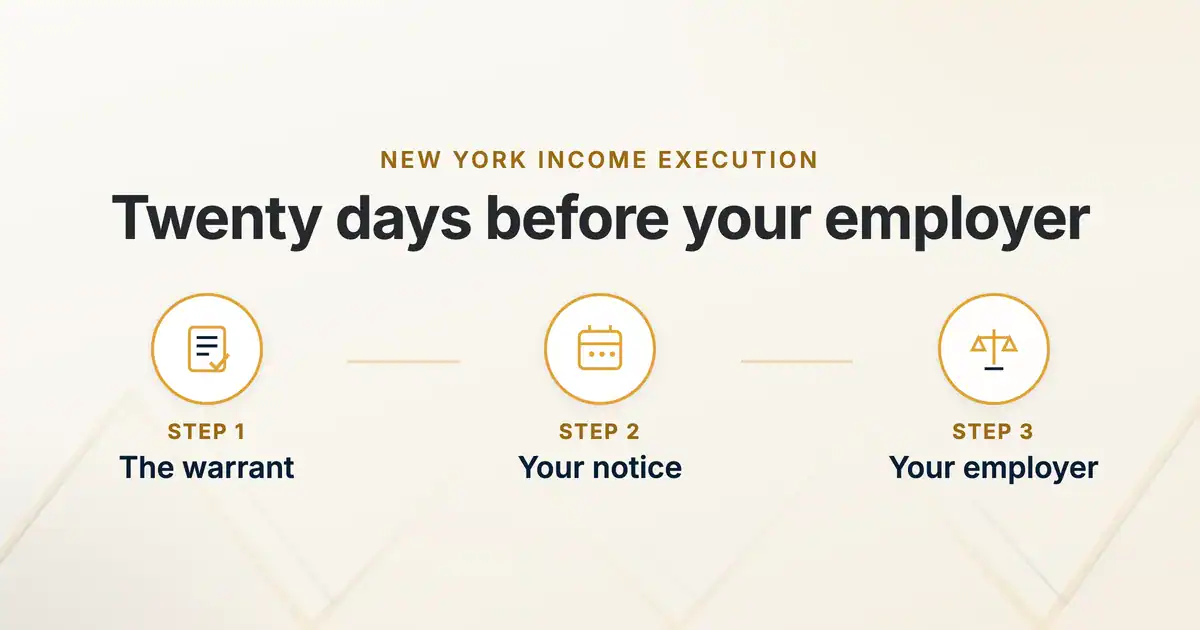
New York gives you a chance the IRS does not. Before the state contacts your employer, it comes to you and asks you to pay voluntarily, and it gives you twenty days to start.
Almost nobody takes it. The notice arrives, it looks like the last several notices, and by the time it is understood the twenty days have gone and payroll has been served.
What a New York Income Execution Is
An income execution is New York State’s wage levy for unpaid tax. The Tax Department asks you to voluntarily pay up to 10 percent of your gross wages each pay period. If you do not, it directs your employer to deduct it automatically. The execution runs until the liability is satisfied.
How It Reaches You
The warrant comes first
The state does not issue an income execution out of nowhere. The Tax Department states that it will file a tax warrant before issuing an income execution. The warrant is the public judgment against you; the income execution is one of the collection tools it unlocks.
That sequencing matters, because if a warrant has been filed there is a separate set of consequences and a separate set of remedies attached to it. We cover those in New York tax warrant help.
The notice goes to you, then to your employer
The income execution is sent first to the address the Tax Department has on file for you. Only if you fail to comply does it go directly to your employer, who then remits on your behalf.
Note the failure mode built into that. If the department’s address for you is old, the first you learn of it is a short paycheck, and the twenty days ran while the notice sat in someone else’s mailbox.
The twenty-day window nobody uses
To comply, you must make the first payment within 20 days of receiving the notice, and then remit 10 percent of your gross income, or 25 percent of your disposable earnings, each time you are paid.
Those twenty days are the whole difference between handling this yourself and having your employer find out. There is nothing to apply for and no form to be approved. You simply pay, on time, in the right amount.
If you share the debt
Where two people owe the same tax debt jointly, the Tax Department can order each of them to pay through a separate income execution. Two households, two paychecks, one liability.
How Much New York Can Take
The stated figure is up to 10 percent of gross wages, or 25 percent of disposable earnings. The Tax Department publishes a payment calculator for working out the required amount, and the exemptions that can reduce it come from Article 52 of the New York Civil Practice Law and Rules rather than from the Tax Department’s discretion.
How that compares with the IRS
This is where taxpayers who have dealt with both get caught out, because the two work in opposite directions.
New York takes a share off the top and leaves you the rest. The IRS leaves you a fixed exempt amount and takes everything above it. On a modest income the state’s 10 percent is the heavier burden in absolute terms only rarely; on a good income the federal levy is far heavier, because the amount you keep does not grow with your earnings. This month’s post on the federal exempt-amount tables works through the arithmetic.
There is a second difference that matters more than the percentages. New York asks first. The IRS, by the time it serves your employer, has already sent a final notice and let the appeal window close.
If Both Are Collecting at Once
It happens more than people expect, because the same unfiled or unpaid year often creates both a federal and a state liability, and the two agencies do not coordinate.
Neither one stops for the other. A New York income execution does not pause because you have an IRS installment agreement, and a federal levy release does not touch the state. Each has to be resolved on its own terms, and the order matters. The one with the harder deadline goes first, and the one taking more of your pay usually goes second only because there is more room to negotiate it.
We wrote about handling both at once in our guide to New York and IRS tax problems, and the New York payment plan route specifically in how the NYS tax payment plan works.
How to End It
Paying the balance in full ends the income execution, and the Tax Department then sends you and your employer a Release of Income Execution. Short of that, the routes are the ones that resolve the underlying liability.
An installment payment agreement with the state is the ordinary answer, and August’s post covers who qualifies. A New York offer in compromise is the route when the balance genuinely cannot be paid, and it works on its own terms rather than as a copy of the federal program, which is exactly why we wrote the NYS offer in compromise and how it differs from the IRS program.
If you are unemployed, or your circumstances do not fit the standard percentage, the Tax Department takes those calls directly and the number is published on its income executions page.
What We Would Do With Twenty Days
Read the notice for the date, because the twenty days run from receipt and everything else is secondary to that.
Check whether a warrant has already been filed, since that changes what else is happening to your credit and your property and it is often news to the taxpayer.
Work out whether 10 percent of gross is actually payable alongside your fixed costs. If it is, start paying it and keep the execution away from your employer. If it is not, that is the conversation to have with the state before the twenty days expire rather than after.
And check the federal side, because a New York balance this size very often has a federal sibling nobody has looked at yet.
We are CPAs in Uniondale, and New York State collection is not a sideline for us. It is a large part of what we do, and it is why we write about the state process in this much detail.
Our wage garnishment work covers both sides. Guy’s bio is here.
If a notice has landed and you are counting days, that is worth a conversation now rather than after payroll has been served.
FAQ
What is a NYS income execution billing notice?
It is the notice the Tax Department sends you before it contacts your employer, telling you that an income execution has been issued and asking you to pay voluntarily. It goes to the address the department has on file. It carries a twenty-day deadline for your first payment, and it is the last stage at which the matter stays between you and the state.
What is an income execution?
A levy against your wages issued by New York State to collect unpaid tax. The department asks you to pay up to 10 percent of your gross wages each pay period, and if you do not, it instructs your employer to deduct up to 10 percent and send it to the state. It remains in effect until the outstanding liability is satisfied, and a tax warrant is filed before it is issued.
How to stop income execution?
Paying the balance in full ends it, and the Tax Department then issues a Release of Income Execution to you and your employer. Otherwise it ends by resolving the underlying debt, through an installment payment agreement with the state or an accepted New York offer in compromise. Exemptions under Article 52 of the CPLR can reduce the amount in limited circumstances. If you are unemployed or the standard percentage does not fit your situation, the department takes those calls directly.