
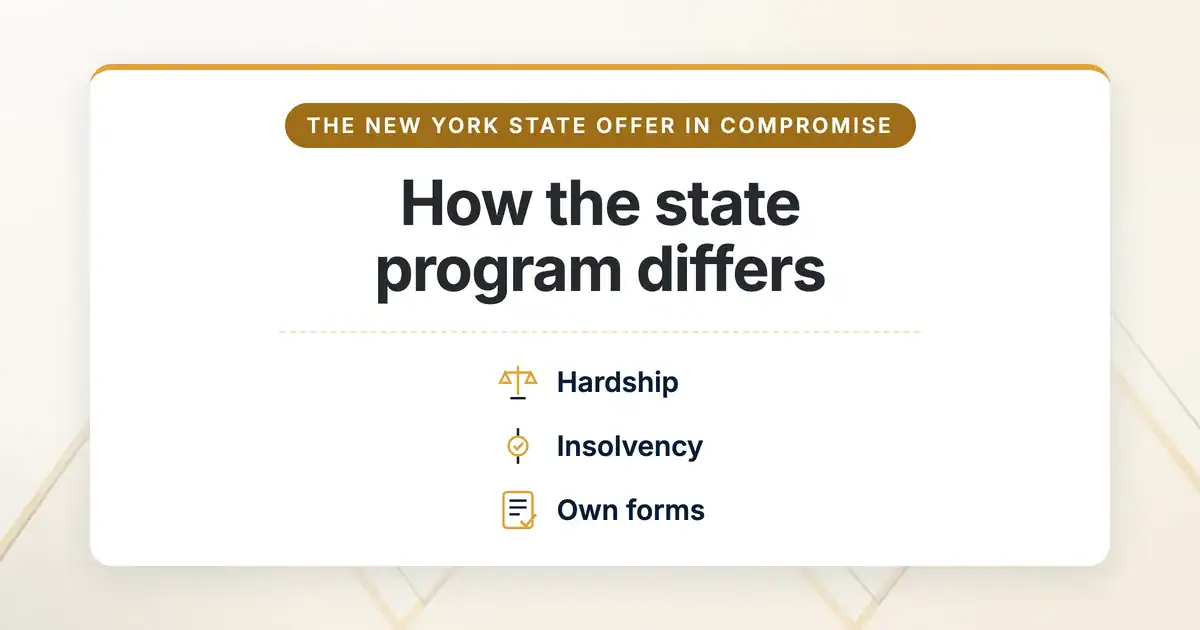
New York State has its own offer in compromise, and it is not the same thing as the IRS program most people have heard of. It lets a taxpayer settle a state tax debt for less than the full balance when paying in full would create real hardship or when the debt cannot realistically be collected. We handle these for Uniondale and Long Island clients who owe the New York State Department of Taxation and Finance. Here is how the New York program works and where it differs from the federal one.
Does NYS Have an Offer in Compromise
It does. The Department of Taxation and Finance, the DTF, accepts offers in compromise from taxpayers who cannot pay a fixed state liability in full and who meet the state standards. It is a genuine settlement program, not a marketing phrase, and it is separate from anything the IRS runs. If your New York balance is more than you can ever realistically pay, or paying it would leave you unable to cover basic living costs, a state offer may be on the table.
How the New York State OIC Program Works
A New York offer asks the state to accept a reduced amount as full settlement of what you owe. You propose a figure, you back it up with financial documentation, and the DTF decides whether that amount is the most it can reasonably expect to collect from you. If the state accepts, you pay the agreed amount and the remaining balance is cleared. The standards the state applies are specific, and getting the framing right is most of the work. If you are carrying a state balance and a federal one at the same time, read our guide to solving New York and IRS problems together to see how the two tracks run alongside each other.
Undue Economic Hardship and Insolvency
New York generally considers an offer under one of two conditions. The first is undue economic hardship, where paying the full balance would leave you unable to meet basic and necessary living expenses. The second is insolvency, where your liabilities exceed your assets and full payment simply is not possible. Which standard your case fits shapes the documentation you file and the amount the state is likely to accept, so it is worth identifying before you submit anything.
Form DTF-4.1 and Form DTF-4
New York uses two different forms depending on where your liability stands. Form DTF-4.1 covers a liability that is fixed and final, meaning the amount is settled and no longer under dispute. Form DTF-4 covers a liability that is not fixed and final, such as one still open to protest or appeal. Filing on the wrong form is a common way an otherwise reasonable offer stalls, and matching the form to the status of your debt is one of the first things we check.
New York City Runs Its Own Separate Program
If part of your debt is New York City tax, note that the city has its own offer in compromise through the NYC Department of Finance, separate from the state DTF program. A taxpayer who owes both the state and the city may need to work both tracks. This is another place where knowing the New York landscape, not just the federal one, changes the plan.
What Qualifies You for an Offer in Compromise
You qualify by showing New York that the amount you are offering is the most it can reasonably collect, given your income, your assets, and your necessary living expenses. It is not about how much you would like to pay, it is about what the numbers support. A strong offer is built on complete, honest financial documentation that lines up with the hardship or insolvency standard your case falls under. A thin or optimistic offer is the kind the state sends back.
Is It Hard to Get Approved for an Offer in Compromise
An offer in compromise is not a guaranteed outcome, and the state does reject offers that are not supported by the financials. That said, a well-documented offer that honestly reflects a taxpayer’s ability to pay has a real path. The difference between an accepted offer and a rejected one is usually the quality of the financial case behind it, not luck. We do not promise a settlement or a specific amount, because no honest firm can, and any firm that does is telling you what you want to hear.
What Is the Downside of an Offer in Compromise
An offer is not free of trade-offs. Preparing one takes time and full financial disclosure, the state can take months to decide, and you generally need to stay current on filings and payments while it is pending. If the offer is rejected, you have spent effort without a settlement, though the underlying options like a payment plan are still there. For some taxpayers a payment plan or a look at settling for less is the better fit, and part of our job is telling you honestly which path your numbers actually support.
How the NYS Offer in Compromise Differs From the IRS Program
The New York and IRS offer programs share a basic idea, settling for less than the full balance, but they are run by different agencies with different forms, different standards, and different review processes. An accepted IRS offer does nothing for a state balance, and a New York settlement does nothing for a federal one. We cover the federal side in our IRS offer in compromise guide, including your realistic approval chances with the IRS. If you owe both New York and the IRS, both have to be worked, and we handle them together.
Where to Start
If you owe New York State more than you can realistically pay, the question worth answering is whether your numbers support a state offer in compromise or whether a payment plan is the smarter move. We look at both before we recommend anything, and we tell you honestly which one your finances actually support. Find out where you stand and we will map the state side, and the federal side too if you owe both.
FAQ
Does NYS have an Offer in Compromise?
Yes. The New York State Department of Taxation and Finance accepts offers in compromise from taxpayers who cannot pay a fixed state liability in full and who meet the state standards of undue economic hardship or insolvency. It is separate from the IRS program and uses its own forms and review.
What is the downside of an Offer in Compromise?
An offer takes time and full financial disclosure to prepare, the state can take months to decide, and you generally must stay current on filings and payments while it is pending. If the offer is rejected you have spent the effort without a settlement, though options like a payment plan remain available.
What qualifies you for an Offer in Compromise?
You qualify by showing that the amount you offer is the most the state can reasonably collect given your income, assets, and necessary living expenses, under either the undue economic hardship or the insolvency standard. Complete, honest financial documentation that supports that amount is what carries an offer.
Is it hard to get approved for an Offer in Compromise?
An offer is not guaranteed, and the state rejects offers that the financials do not support. A well-documented offer that honestly reflects your ability to pay has a real path, and the quality of the financial case behind it is usually what separates an accepted offer from a rejected one.