
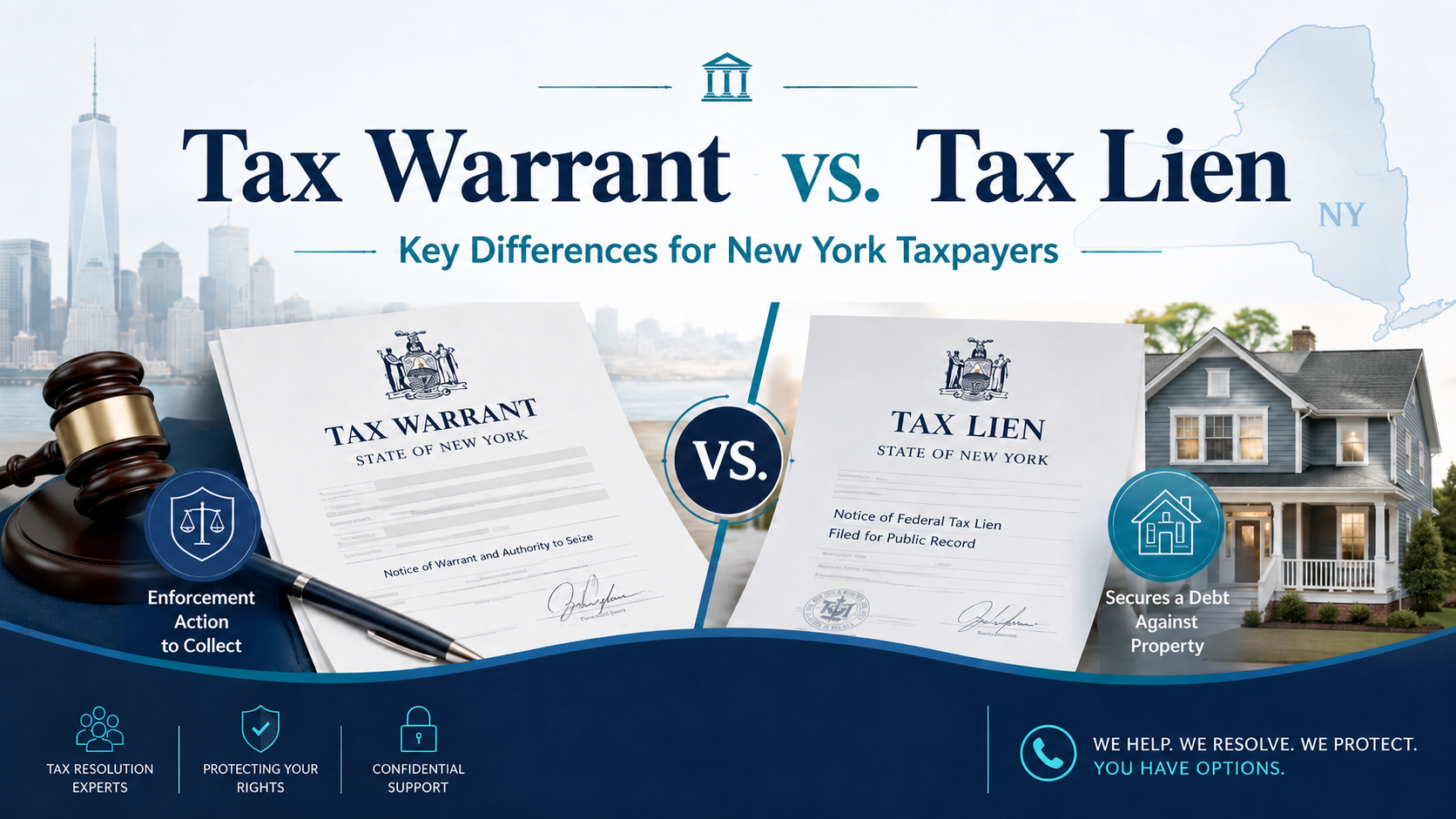
If you received a notice about a tax warrant, saw a tax lien show up during a property search, or heard both terms used in the same conversation, it is easy to feel confused. The words sound similar. They are often connected. And in New York tax cases, they can affect your finances, property, wages, and ability to move forward.
The good news is that a tax warrant is not the same thing as an arrest warrant. The difficult news is that it is still serious. A New York tax warrant is generally a civil collection action tied to unpaid tax debt. Once it is filed, it can create a lien against real and personal property, become a public record, and lead to more aggressive collection actions if the balance is not addressed.
If you are not sure where your case stands, start with this simple explanation: a tax warrant is the state’s formal filing, and the lien is the legal claim that can attach to your property because of that filing. For a broader overview of the process, read our guide to New York tax warrant help.
What Is a Tax Warrant?
A tax warrant is a legal filing used by New York State when a tax debt has become fixed, final, and unresolved. In practical terms, it means the state has moved from sending notices and requesting payment into a stronger collection position.
A tax warrant can be filed with the New York State Department of State and the county clerk’s office listed on the warrant. Once filed, it can become a public record and may affect your ability to buy, sell, or refinance property.
This is why a warrant can create problems even before money is taken from a bank account or paycheck. You may first notice the impact when a lender, title company, business partner, or creditor finds the warrant during a review.
A tax warrant can also be a warning sign that other collection actions may follow. If the balance is not resolved, the state may look at wage collection, bank levies, or other ways to collect. If you are already worried about enforcement, our page on tax levy help explains what can happen when a taxing authority starts taking property or funds.
Understanding New York Tax Liens and Property Claims
A tax lien is a legal claim against property because of unpaid tax debt. It does not always mean the state has taken your property, but it can give the state a secured interest in what you own.
For many New York taxpayers, this is where the confusion starts. A person may receive a notice about a tax warrant, but a lender or title company may describe the problem as a lien. Both may be referring to the same underlying issue: unresolved tax debt that has created a legal claim against property.
A lien can matter if you own a home, business property, vehicles, equipment, or other assets. It can also create problems if you are trying to borrow money, sell real estate, transfer property, or clean up your financial record.
If you are dealing with a lien connected to back taxes, you may also want to review our tax lien help page for more information about how liens can affect taxpayers and what options may exist.
Tax Warrant vs. Tax Lien: The Simple Difference
The simplest way to understand the difference is this:
- A tax warrant is the official collection filing.
- A tax lien is the legal claim against property that can result from that filing.
In New York, a tax warrant can create a lien against real and personal property. That is why the two terms often appear together. The warrant is the action the state files. The lien is one of the legal effects of that action.
| Issue | Tax Warrant | Tax Lien |
| What it is | A formal collection filing by the state | A legal claim against property |
| How it starts | Filed after unresolved tax debt reaches collection status | Often created by the filed warrant |
| What it affects | Public record, collection posture, future enforcement | Property, title, financing, sales, refinancing |
| What taxpayers feel | Fear, confusion, urgency | Concern about assets, credit, property, and financing |
| What to do next | Confirm the balance, years, and case status | Find out how the lien affects property and what resolution path is available |
Does a Tax Warrant Mean the State Can Take Your Property?
Not automatically, but it can move the state closer to enforcement.
A tax warrant can create a lien against your property. That lien can interfere with selling, refinancing, or transferring property. It can also give the state leverage if the debt continues to go unresolved.
There is a difference between a lien and a levy. A lien is a claim. A levy is a seizure. That distinction matters because many taxpayers panic when they hear “lien” and assume money has already been taken. A lien may be serious, but a levy is the point where property or funds may actually be seized.
If you are worried that your bank account could be frozen or funds could be taken, review our page on IRS tax levy help. If your paycheck is already being affected, our wage garnishment help page explains common next steps.
Can a Tax Warrant Affect Selling or Refinancing a Home?
Yes. This is one of the most common ways taxpayers discover how serious a tax warrant can be.
A filed warrant can create a lien against real property. If you are trying to sell a home, refinance, or use property as collateral, the lien may need to be addressed before the transaction can move forward. Sometimes the issue appears during a title search. Other times, a lender flags it during underwriting.
This can be especially stressful when you are already under a closing deadline. People often assume they only need to “set up a payment plan,” but property transactions may require a more specific strategy, such as getting a payoff amount, reviewing whether the balance can be paid at closing, or exploring whether a release or subordination may be possible.
If your tax warrant is connected to a broader New York tax problem, our guide to New York tax problems may help you understand how state and IRS issues can overlap.
Can a Tax Warrant Lead to Wage Garnishment or a Bank Levy?
Yes. A tax warrant can be part of the path toward stronger collection action. If the debt remains unresolved, the state may pursue collection through wages, bank accounts, or other third parties.
For wage-related collection, New York may use an income execution. For bank accounts or other property, the state may use a levy. These actions can be financially disruptive because they affect the money you depend on for rent, payroll, mortgage payments, household expenses, and basic cash flow.
This is why it is important to act before the case moves from “filed warrant” to active enforcement. If you have received notices but nothing has been taken yet, that may be the window where a stronger plan can still prevent the worst outcome.
Depending on your situation, that plan may involve getting missing returns filed, reviewing an installment agreement, exploring an offer in compromise, or building another resolution strategy that fits your financial reality.
Why Taxpayers Often Confuse Warrants, Liens, and Levies
Most taxpayers are not tax professionals, and the notices are not always easy to understand. You may see one word in a state notice, another word in a lender’s report, and a different word when searching online. That confusion can lead to two risky reactions: panic or avoidance.
Panic can push you into agreeing to a payment you cannot afford. Avoidance can allow the state’s timeline to keep moving. Neither one creates a stable resolution.
The better approach is to slow down enough to diagnose the actual issue:
- What tax years are involved?
- Is the debt personal, business, payroll, sales tax, or another type of tax?
- Has a warrant already been filed?
- Has a lien affected property or financing?
- Is there any active wage, bank, or asset collection?
- Are all required tax returns filed?
- Is the taxpayer current with new tax obligations?
These facts matter. A taxpayer with unfiled returns may need a different first step than someone who is fully filed but cannot afford the balance. A business owner with payroll tax problems may need a different strategy than an individual with personal income tax debt.
If missing returns are part of the problem, our delinquent tax returns page explains why filing compliance is often a key part of resolving tax debt.
The Biggest Mistake: Treating a Tax Warrant Like “Just Another Notice”
By the time a tax warrant enters the picture, the issue has usually moved beyond basic reminder letters. That does not mean you are out of options. It does mean the problem deserves focused attention.
One common mistake is assuming that nothing serious will happen because nothing has happened yet. A quiet period does not always mean the case is safe. It may simply mean the state has not moved to the next enforcement step yet.
Another mistake is trying to self-diagnose based only on the balance shown online. The balance is not the full story. You need to know what years are involved, how the balance was assessed, whether returns were filed correctly, whether penalties are driving the amount, and whether there are state and IRS issues happening at the same time.
The goal is not just to make the warrant disappear as quickly as possible. The goal is to resolve the case in a way that protects your property, income, cash flow, and long-term compliance.
What to Do If You Have a Tax Warrant or Tax Lien in New York
If you are facing a tax warrant or tax lien, take these steps before agreeing to anything or assuming the worst.
1. Gather every notice you have received
Pull together state tax notices, IRS notices, county clerk records, lender letters, title company emails, and any payment agreement information. Even older letters can matter because they help show the timeline.
2. Identify the tax years and tax types involved
Find out whether the issue is related to personal income tax, business tax, payroll tax, sales tax, or another liability. The type of tax can change the strategy.
3. Confirm whether all required returns are filed
Resolution options are often limited when returns are missing. If the state or IRS is working from estimated or incomplete information, the balance may not tell the full story.
4. Review your financial reality before choosing a plan
A payment plan is only helpful if it is sustainable. If you agree to more than you can afford and default later, the case can become harder to fix.
5. Get help before a property transaction or enforcement deadline
If a warrant or lien is blocking a sale, refinance, or business transaction, timing matters. Do not wait until the last few days before closing to find out what documentation or payoff information is needed.
When Professional Help Makes Sense
You may want professional help if a tax warrant has already been filed, a lien is affecting your property, you received notice of an income execution, you are worried about a bank levy, or you owe for multiple years.
Professional help is also important if you own a business, have payroll tax issues, have missing returns, or cannot afford the payment the state wants. Business tax problems can escalate quickly and may affect cash flow, employees, vendors, and personal finances.
At Fine & Clear Tax Solutions, the first step is not guessing. It is understanding what was filed, what is owed, what notices were issued, what deadlines matter, and what options are realistic. From there, a resolution plan can be built around the facts of the case.
If you need help understanding a tax warrant, lien, levy risk, or state tax collection issue, contact Fine & Clear Tax Solutions for a confidential consultation.
Final Takeaway
A tax warrant and a tax lien are not exactly the same thing, but in New York they are closely connected. A tax warrant is the official filing. The lien is the legal claim that can attach to your property because of that filing.
The most important thing is not to ignore either one. A tax warrant can affect property, financing, wages, bank accounts, and your ability to move forward financially. But with the right strategy, you may be able to stabilize the case, prevent further damage, and work toward a resolution.
If you are dealing with a New York tax warrant or tax lien, Fine & Clear Tax Solutions can help you understand your options and take the next right step. Schedule a confidential consultation today.
Frequently Asked Questions
Is a tax warrant the same as a tax lien?
No. A tax warrant is the official collection filing. A tax lien is the legal claim against property that can result from that filing. In New York, a filed tax warrant can create a lien against real and personal property.
Does a New York tax warrant mean I am going to jail?
In most cases, no. A New York tax warrant is generally a civil collection action for unpaid tax debt, not an arrest warrant. It is still serious because it can affect property, wages, bank accounts, and future collection activity.
Can I sell my house if I have a New York tax warrant?
A filed warrant can create a lien that may interfere with selling or transferring property with clear title. Depending on the facts, the balance may need to be paid, addressed at closing, or reviewed for a possible release or subordination.
Can New York garnish my wages after filing a tax warrant?
Yes, wage collection may happen through an income execution if the tax debt remains unresolved. The state may also pursue other collection actions depending on the case.
What should I do first if I find out there is a tax warrant against me?
Start by confirming what years and tax types are involved, whether all required returns are filed, and whether the state has started additional collection action. Then review your resolution options before agreeing to a payment you may not be able to maintain.
Can a payment plan remove a tax warrant?
A payment plan may help prevent additional collection action, but a warrant may remain on file until the warranted balance is paid in full. The right approach depends on the amount owed, your financial situation, and whether property or enforcement issues are involved.